
11 Best Social Media Automation Tools for 2026: Why Traditional Schedulers Fall Short

Social media automation in 2026 has evolved far beyond simple calendar queues and distribution grids. While early automation software focused primarily on scheduling pre-made posts through network APIs, modern teams face a fundamentally different challenge: creative content execution at scale. The primary bottleneck for founders, digital marketers, and growth agencies is no longer pushing posts live at specific times—it is generating high-quality visual assets, writing channel-specific copy, and maintaining brand identity without spending hours inside manual graphic design software.
Traditional social media schedulers treat content creation as an external prerequisite. They require teams to draft graphics in one tool, write captions in another, format dimensions manually, and upload finalized files into a publishing queue. As content demands increase across platforms like LinkedIn, X, Instagram, and TikTok, this manual operational model creates unsustainable friction. In 2026, leading tools integrate visual design generation, context-aware copywriting, and autonomous execution into unified workflows.
Below is a comprehensive analysis of the 11 best social media automation tools for 2026, comparing their capabilities across visual asset creation, operational overhead, workflow efficiency, and strategic execution.
The Shift in Social Media Automation: Why Traditional Schedulers Fall Short
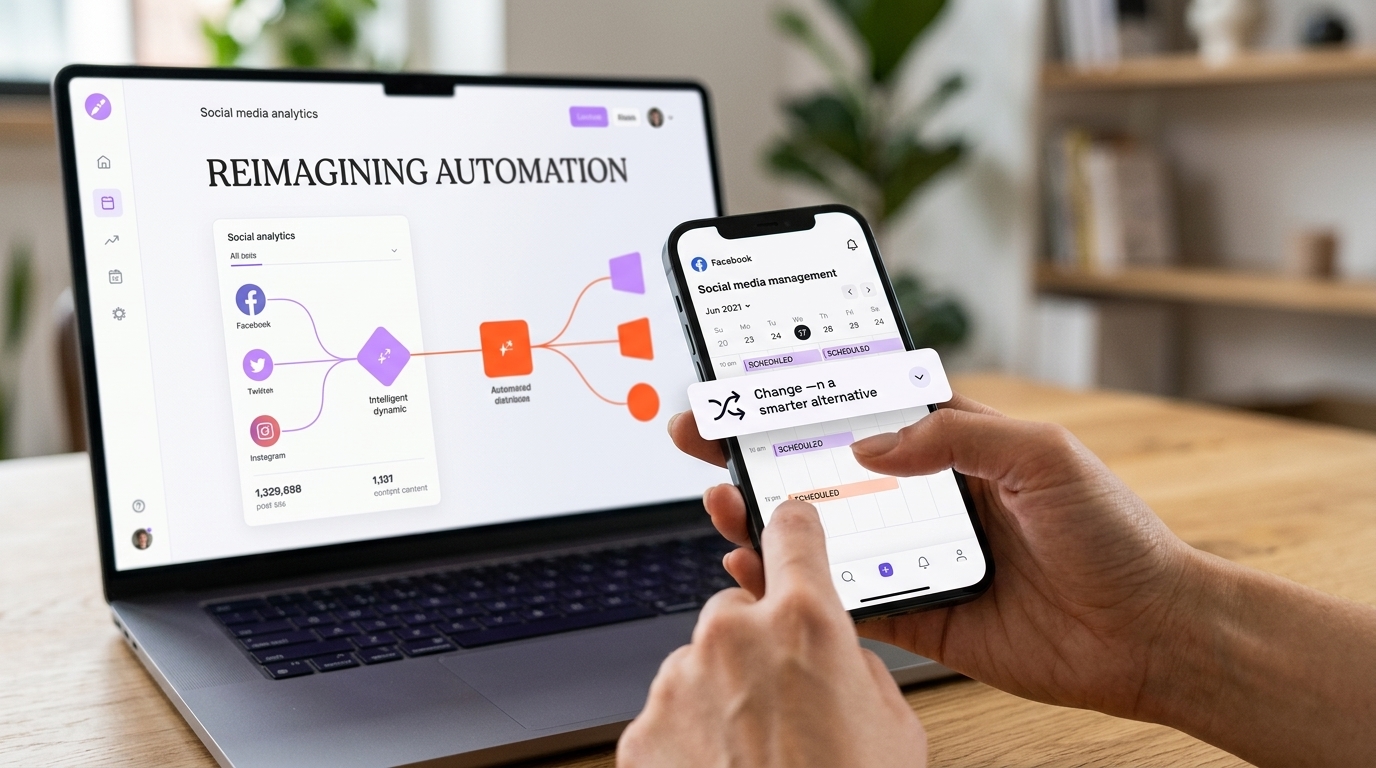
Legacy social media tools were engineered for an era when publishing frequency and basic timing optimization were enough to secure reach. Modern platform algorithms, however, prioritize visual quality, original commentary, and native design standards. Relying on simple scheduling tools creates three major operational friction points:
- Visual Asset Bottlenecks: Traditional platforms hold empty queues until you supply finished images or videos. Creating these assets requires manual effort inside visual design software or reliance on stock templates that look generic and uninspired.
- Fragmented Workflows: Managing social channels across legacy stacks forces creators to jump between copy generators, image editors, spreadsheet calendars, and scheduling dashboards.
- Operational Fatigue: Instead of acting as strategic direction-setters, founders and marketing leads spend hours aligning fonts, tweaking aspect ratios, and manually reviewing calendar slots.
True automation in 2026 shifts the user from an operational manager executing micro-tasks to an executive reviewer approving complete campaigns.
The Data Behind the Shift
Recent benchmarks highlight why traditional schedulers are falling short. According to Emplifi's 2026 social publishing benchmarks, static scheduling ignores the "no-post penalty," where accounts underperform their own baseline growth during periods of inactivity [1]. Additionally, enterprise-level manual scheduling is highly inefficient, with teams burning over 1,300 hours annually on time-zone math [1]. HubSpot's 2026 Social Media Marketing Report, based on data from 1,100+ global marketers, reveals that only 36% of marketers report their current tool stack is fully integrated [2]. This fragmentation directly contributes to the operational fatigue described above.
Meanwhile, AI-powered predictive scheduling enables autonomous, per-post optimization [1]. The adoption of AI is nearly universal: 94% of marketers now use AI in their workflows [2]. Marketers using AI tools save an average of 5.1 hours per week [4]. AI-optimized posting improves organic reach by 22% and engagement rates by 29% compared to manual scheduling [4]. These numbers make a compelling case for moving beyond traditional schedulers.
However, AI is not without challenges. 61% of marketers cite originality and plagiarism as top risks [5], and while 71% report time savings [5], only 37% find it easy to connect social activity to business outcomes [2]. Therefore, the most effective 2026 strategies prioritize predictive AI for scheduling alongside human-led creative refinement [1][5].
The 11 Best Social Media Automation Tools for 2026
1. Anomalia
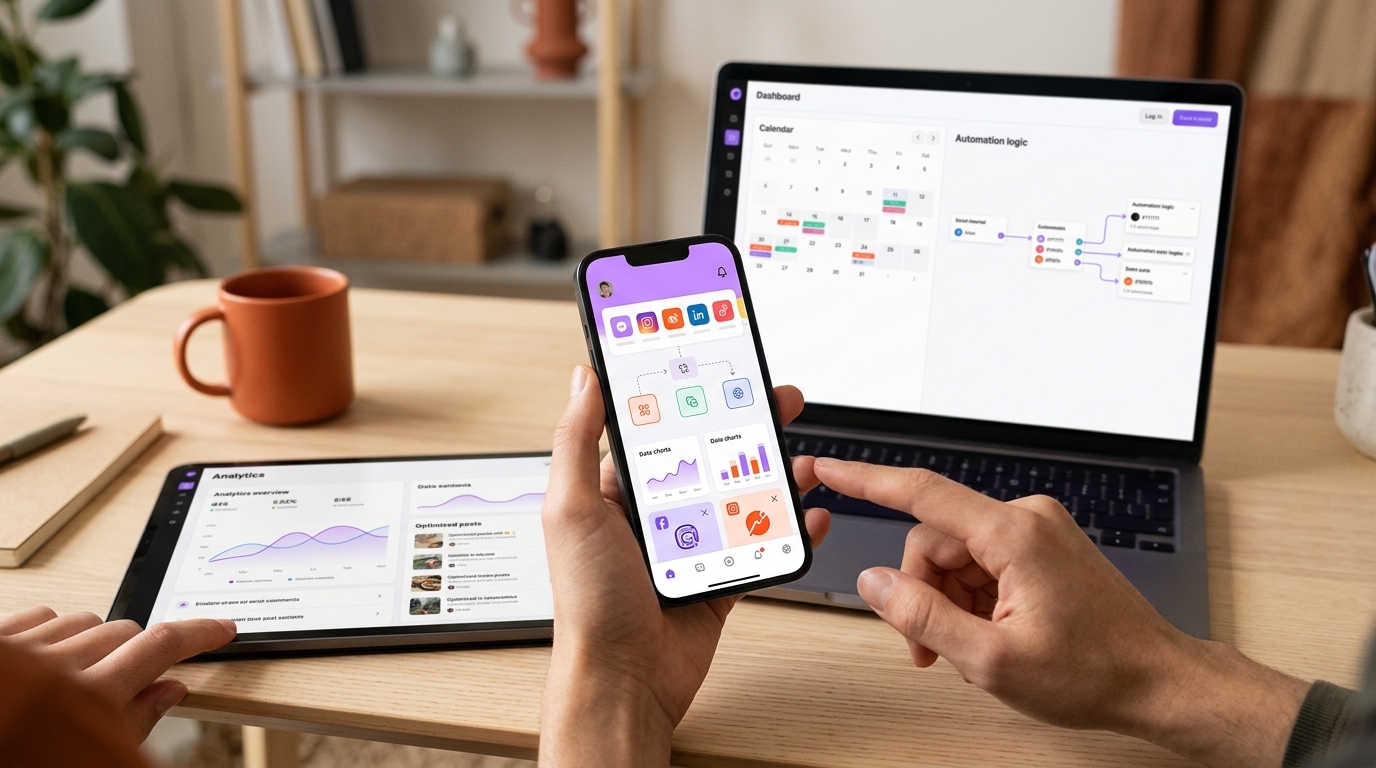
Anomalia represents a shift toward autonomous AI social media management. Designed specifically for technical founders, solopreneurs, and growth-focused agencies, Anomalia eliminates manual production tasks by generating bespoke visual assets, writing context-specific copy, and handling cross-platform formatting automatically.
Rather than forcing users to navigate complex design canvases or build manual post queues, Anomalia operates as an automated content production team. It transforms raw ideas, product updates, or web content into polished visual posts ready for distribution. With Anomalia, you can put your social media on autopilot without looking robotic Anomalia Autopilot.
- Best for: Technical founders, lean startups, non-designers needing premium visual branding, and agencies scaling content output.
- Core strength: Autonomous end-to-end asset generation, brand-consistent visual design, and a streamlined single-tap content approval process.
- Limitations: Tailored for rapid execution rather than corporate multi-tier approval chains.
2. Buffer
Buffer remains a standard utility platform for scheduling content across social networks. Its lightweight interface and stable API connections make it a popular choice for straightforward post queuing.
However, Buffer operates strictly as a distribution channel. While it includes basic AI writing prompts to refine caption text, it offers no native visual design automation. Users must create and upload all images, graphics, and video files independently.
- Best for: Lean teams and solo creators who already have an established visual design asset pipeline.
- Core strength: Clean user interface, affordable pricing tiers, and reliable queue management.
- Limitations: Lacks visual creation tools, autonomous workflow capabilities, and native graphics design.
3. Hootsuite
Hootsuite is an enterprise-grade social management platform designed for mid-to-large organizations requiring multi-account governance, complex approval workflows, and deep social listening.
While Hootsuite provides extensive channel integration and team management features, its workflow model remains heavily manual. Setting up campaigns, managing assets, and maintaining queues requires significant daily oversight, making it overly complex and expensive for smaller teams or early-stage founders.
- Best for: Enterprise marketing departments and corporate teams requiring multi-tiered permission governance.
- Core strength: Robust analytics, broad network support, centralized social listening, and governance features.
- Limitations: High subscription costs, steep learning curve, and substantial operational overhead.
4. Later
Later built its reputation around visual social media planning, offering drag-and-drop feed planning optimized for platforms like Instagram, TikTok, and Pinterest.
While its visual grid planner helps brands maintain a cohesive aesthetic before publishing, Later functions primarily as a digital asset holder. It does not generate visual graphics, custom typography, or original brand imagery. Users must import finished design files created externally.
- Best for: E-commerce brands and visual creators with large pre-existing photo and video libraries.
- Core strength: Intuitive drag-and-drop grid preview and visual content calendar.
- Limitations: No autonomous graphic design capabilities or AI visual creation tools.
5. SocialBee
SocialBee specializes in category-based post scheduling, allowing users to organize content into distinct buckets—such as educational tips, promotional announcements, and industry updates—and re-queue evergreen posts automatically.
This structured approach helps keep publishing feeds active, particularly for text-heavy content or link sharing. However, relying on recycled content without updating visual graphics can lead to engagement decline on modern visual platforms.
- Best for: Content marketers and bloggers managing extensive libraries of written, evergreen content.
- Core strength: Flexible category management and automated content recycling rules.
- Limitations: Limited native design tools and risk of visual content fatigue from repeated posts.
6. Sprout Social
Sprout Social is an enterprise-level platform combining social media publishing, deep listening analytics, and customer service management into a single corporate hub.
It provides advanced reporting metrics, team productivity tracking, and unified inbox capabilities. However, Sprout Social is built on the assumption that an organization already has a dedicated creative team producing visual assets and copy externally.
- Best for: Mid-market to enterprise brands prioritizing customer support integration and high-level analytics.
- Core strength: Detailed reporting, unified inbox management, and brand sentiment tracking.
- Limitations: Premium pricing model and zero automated creative asset generation.
7. Canva
Canva transformed digital graphics creation by offering non-designers accessible layout templates, typography controls, and stock libraries. In recent years, it added social scheduling tools and basic AI generation features directly within its visual editor.
Despite these additions, Canva remains a hands-on design tool. Users must manually select layouts, swap assets, adjust alignment, and write accompanying text. For busy founders and operators, spending time manipulating design templates detracts from core business growth.
- Best for: Marketers and creators who prefer hands-on visual editing without professional design software.
- Core strength: Extensive library of customizable layout templates and easy media editing.
- Limitations: Time-consuming manual editing process and potential for generic, template-driven visuals.
8. Predis.ai
Predis.ai focuses on generating short-form video reels, carousel graphics, and social captions from text prompts or product URL links. It combines stock footage, text overlays, and automated audio synthesis to create ready-to-post media.
While it accelerates post production compared to traditional template editors, the generated visual outputs often retain a noticeable synthetic appearance. For technical brands or premium services, using unrefined stock combinations can compromise brand credibility.
- Best for: E-commerce storefronts seeking rapid creation of short video posts from catalog items.
- Core strength: Fast conversion of product links and text prompts into multi-frame videos and carousels.
- Limitations: Visual styling can appear generic or synthetic without extensive manual adjustments.
9. Jasper
Jasper is an AI copywriting assistant engineered for marketing teams, capable of generating social media copy, blog outlines, ad scripts, and long-form written content using customized brand voice parameters.
While Jasper excels at generating written messaging, it leaves visual production entirely unaddressed. Captions drafted in Jasper still require manual pairing with custom graphics, images, or video assets before publication.
- Best for: Copywriters and content strategists focused on text generation and messaging variation.
- Core strength: High-quality tone-of-voice control, structured templates, and long-form writing support.
- Limitations: Lacks graphic design, image creation, and automated publishing capabilities.
10. MeetEdgar
MeetEdgar automates social media distribution by building a permanent library of past posts and automatically re-publishing them whenever a feed runs out of new content.
While this guarantees continuous activity on profiles, social media platform algorithms increasingly prioritize fresh, original visual assets over repeated link posts. Relying solely on archived re-shares can hurt organic reach and audience engagement over time.
- Best for: Solopreneurs wanting automated maintenance for static link repositories.
- Core strength: Continuous automated re-publishing from stored content libraries.
- Limitations: Outdated approach for platforms requiring unique, high-quality visual content.
11. Zapier and Make
Zapier and Make are workflow automation engines that enable technical users to build custom publishing pipelines by connecting database APIs, AI language models, image processing services, and social media webhooks.
This approach offers complete customization for developers and technical operators. However, building and maintaining custom integrations requires ongoing engineering effort, error-handling logic, and constant API updates across multiple platform providers.
- Best for: Technical teams and software engineers who prefer building custom, owned automation pipelines.
- Core strength: Total workflow flexibility and integration capabilities across thousands of web apps.
- Limitations: High technical complexity, zero native visual editing interface, and ongoing maintenance burden.
How to Choose the Right Tool for Your Team
Selecting the right social media automation tool depends on your team's size, technical expertise, and content production needs. Here are key considerations:
- If you're a founder or small team with limited design resources: Anomalia's autonomous content generation can save you hours each week. You can also use Anomalia's free tools like the Best Time to Post tool to optimize your posting schedule without manual research.
- If you have an in-house design team: Traditional schedulers like Buffer or Later may suffice, but you'll still face the operational overhead of managing assets externally.
- If you need enterprise governance and analytics: Hootsuite or Sprout Social offer robust features, but at a premium cost and with a steep learning curve.
- If you're a technical team comfortable with APIs: Zapier and Make provide ultimate flexibility, but require ongoing engineering effort.
Remember, the goal is to reduce operational friction and free up time for strategic work. As the data shows, AI-powered tools can save over 5 hours per week [4] and improve engagement by 29% [4].
The Future: Autonomous AI Agents
The trend is clear: social media automation is moving toward autonomous AI agents that handle the entire content lifecycle—from idea to published post. Anomalia is at the forefront of this shift, offering a social media strategy built by AI, approved by you. This approach not only saves time but also ensures brand consistency and originality, addressing the top concern of 61% of marketers [5].
If you're struggling with low engagement or lack of time, consider exploring Anomalia's engagement solutions or consistency tips. The future of social media management is not about scheduling—it's about intelligent, automated content creation.
Conclusion
Traditional social media schedulers are no longer sufficient in 2026. They fail to address the core challenges of visual asset creation, workflow fragmentation, and operational fatigue. The best tools now integrate AI-driven content generation, predictive scheduling, and autonomous execution. Whether you choose Anomalia for its end-to-end automation or another tool from this list, prioritize solutions that save you time and improve engagement. As the statistics show, AI adoption is nearly universal, and the benefits are clear: 5.1 hours saved per week and a 29% boost in engagement [4]. Make the shift today and put your social media on autopilot—without looking robotic.
References
- 2026 social publishing benchmarks: Moving beyond the "best time to post"
- HubSpot's 2026 Social Media Marketing Report
- The State of Social Media Engagement in 2026
- AI Social Media 2026: 5.1 Hrs/Week Saved
- 2026 AI in social media marketing report
See also: Best AI tools for social media
See also: The Cost of the Click: A
See also: The Death of the Social Media